
Learning science
Does AI make you worse at learning? What the research actually shows
Key takeaways
- AI harmed learning in the studies where it did the learner’s retrieval, writing or reasoning, and helped or did no harm where it was designed to make the learner do that work.[1][10][12]
- In a randomised trial with nearly 1,000 high-school students, unrestricted GPT-4 raised practice scores by 48% and lowered exam scores by 17%; a hint-only version avoided the drop.[1]
- A Harvard physics AI tutor that guided students step by step produced median learning gains more than double those of in-class active learning, measured right after the lesson.[10]
- The most quoted evidence, the MIT EEG essay study, is a small preprint: it shows lower engagement during one writing task, not lasting harm.[5][6]
- The practical rule: let AI prepare and explain, but attempt first, ask for hints instead of answers, recall with the chat closed, and re-test days later.
Some headlines say ChatGPT makes you dumber. Others say AI tutors double learning gains. We read the studies behind both, put them in one table, and found the single condition that decides which result you get. Then we turned it into eight rules for studying with AI that you can test on yourself.
Does AI make you worse at learning?
Not by itself. The studies that find harm share one feature: the AI did the remembering, the answering or the reasoning that the learner was supposed to practise. When a tool is built so the learner still does that work, the same technology gives equal or better results.
If you searched “does AI make you dumber”, you have probably seen headlines about an MIT brain-scan study or a Microsoft survey. This article reads the papers behind those headlines, including the less famous randomised trials, and explains why studies that seem to disagree actually agree once you ask one question: who did the thinking?
Across the 2024–2026 studies, AI harmed learning when it replaced the learner’s retrieval, generation or reasoning, and helped or did no harm when it was designed to make the learner do that work.[1][10][12]
What this article adds that a news summary does not: one table of 11 studies with their sample, design and main caveat; a framework that sorts them by who did the work; and a checklist of rules, each with a way to check whether you followed it.
What do the studies that say AI harms learning actually show?
They show lower scores once the AI is taken away, shallower reasoning, and weaker memory for work people produced with AI. The strongest are randomised experiments; the rest are surveys or small preprints, and the difference matters.
High-school math in Turkey (PNAS, 2025)
Bastani and colleagues ran a randomised trial with nearly 1,000 students in grades 9 to 11 at a high school in Turkey, across four 90-minute math sessions.[1] One group used a plain GPT-4 chat interface (“GPT Base”). Another used the same model with hidden, teacher-written instructions to give step-by-step hints instead of answers (“GPT Tutor”). A control group used the textbook and class notes.
During practice, GPT Base students scored 48% higher than the control group and GPT Tutor students 127% higher. On the exam, taken without AI, GPT Base students scored 17% lower than the control group, while GPT Tutor students were statistically no different from it.[1] Chat logs showed that many GPT Base students simply asked for the final answer, and that the unrestricted model’s answers were correct only about half the time.
Retention after 45 days (2025)
Barcaui randomly assigned 120 business undergraduates in Brazil to study AI concepts either with ChatGPT or with course notes, databases and ordinary search.[2] On a surprise test 45 days later, the ChatGPT group averaged 57.5% correct and the other group 68.5% (Cohen’s d = 0.68). The ChatGPT group studied less (3.2 versus 5.8 hours), but the gap held after adjusting for time. About 30% of participants did not take the final test, and everyone came from one university.
Developers learning a new library (2026, preprint)
Shen and Tamkin, researchers at Anthropic, randomly assigned 52 mostly junior developers to learn the Python library Trio with or without an AI assistant.[3] The AI group scored 50% on the quiz that followed, against 67% for those who coded by hand (d = 0.74), and was not significantly faster. Those who only asked conceptual questions, or generated code and then asked follow-ups until they understood it, scored 65% or more; those who handed the work over scored below 40%. That comparison is observational, with small subgroups.
Less effort, shallower reasoning (2024)
Stadler, Bannert and Sailer gave 91 university students 20 minutes to research a health question, either with Google or with ChatGPT.[4] ChatGPT users reported lower mental load on every measure, but their written recommendations contained fewer relevant justifications (1.20 versus 1.87). The drop in germane load, the effort spent building understanding, statistically accounted for the difference.
The MIT “Your Brain on ChatGPT” study (preprint)
Kosmyna and colleagues at the MIT Media Lab recorded EEG from 54 adults who wrote essays with ChatGPT, with a search engine, or with no tools.[5] The no-tool group showed the strongest brain connectivity and the ChatGPT group the weakest; ChatGPT users also struggled to quote essays they had written minutes earlier.
Read it with care. It is a preprint, only 18 people completed the session where groups switched conditions, it tested one task and one tool, and a comment posted on arXiv questions its sample size, EEG methods and reporting.[5][6] It shows lower engagement during one writing task, not lasting damage, and the authors call their conclusions preliminary.
Better essays, no extra learning (2025)
Fan and colleagues randomly assigned 117 university students to write with ChatGPT, a human expert, writing analytics tools or no extra help.[7] The ChatGPT group improved its essay scores the most, yet gained no more knowledge and showed no better transfer than the other groups, and it regulated its own learning differently. The authors call the risk “metacognitive laziness”: letting the tool do the planning and monitoring that learners normally do themselves.
Two surveys: offloading and confidence
Gerlich surveyed and interviewed 666 people and found that more frequent AI use correlated with lower critical-thinking scores, a link that ran through cognitive offloading; younger participants relied on AI most.[8] Lee and colleagues at Microsoft Research and Carnegie Mellon surveyed 319 knowledge workers about 936 real tasks: the more people trusted the AI, the less critical thinking they reported, and the more they trusted their own ability, the more they reported.[9] Both are correlational and partly self-reported, so they cannot show that AI caused the difference.
Then why do other studies find that AI tutors double learning gains?
Because those tutors were built to keep the student working. The best-known positive trial did not hand students a general chatbot; it gave them a tutor scripted around the course, step by step.
Kestin and colleagues ran a crossover trial in Harvard’s introductory physics course for life-science students, analysing 194 students.[10] Each student spent one week learning a topic from an AI tutor at home and one week in an in-class active-learning lesson, which is a demanding comparison rather than a lecture. The tutor walked students through each part of each problem in order, using instructor-written prompts and step-by-step solutions supplied so it would stay accurate.
Median post-test scores were 4.5 after the AI lesson against 3.5 after class, and the authors report median learning gains more than double, in less time (median 49 minutes).[10] The limits are real: the test came right after the lesson, building the system took months, and long-term retention was not measured.
Two more results fit the same pattern. A World Bank randomised trial in Nigeria found that six weeks of GPT-4 tutoring for first-year senior secondary students raised English scores by 0.23 standard deviations (a working paper, not yet peer reviewed).[11] And Lehmann, Cornelius and Sting found no overall effect of LLM access in two pre-registered lab experiments, but a clear split by use: students who had the LLM produce exercise solutions covered more topics and understood each one less, while students who asked it for explanations understood the material more deeply.[12] LLM access also widened the gap between students with low and high prior knowledge.
One warning about the optimistic side. A widely cited 2025 meta-analysis reporting large learning gains from ChatGPT was retracted in 2026, after the editor lost confidence in its analysis.[13] Positive headlines deserve the same scrutiny as scary ones.
In the PNAS trial, the same GPT-4 model lowered exam scores by 17% when it answered freely and caused no measurable harm when teacher-written prompts made it give hints instead.[1]
Why would skipping the effort hurt memory?
Because the effort is where the learning happens. Decades of memory research show that producing an answer, retrieving it and struggling a little are what make knowledge last, and that all three feel worse in the moment than reading a fluent explanation.
- Generation effect. Words people produced themselves from a cue were remembered better than the same words simply read, on both recall and recognition tests.[14]
- Testing effect. Students who practised recalling a passage remembered 61% of it a week later, against 40% for students who reread it. The rereaders predicted they would remember the most.[15]
- Desirable difficulties. Spacing, interleaving, generating and testing make practice feel harder and often look worse during learning, yet improve long-term retention and transfer. Performance during practice is a poor guide to how much you learned.[16]
- Cognitive offloading. Using the world around you, a note, a calculator or now a chatbot, to cut the mental demand of a task is normal and often sensible. The research also describes its cost: what you offload, you are less likely to keep in your own memory.[17]
The worry is older than chatbots. In 2011 Sparrow, Liu and Wegner reported that people who expected to keep access to information remembered the information itself less well, and where to find it better.[18] A large 2018 project that re-ran social-science experiments published in Nature and Science did not reproduce the result it tested from that paper,[19] so treat the “Google effect” as plausible rather than settled. The generation and testing effects rest on a much broader base of experiments.[16]
Practice performance with AI is not learning: students using unrestricted GPT-4 scored 48% higher during practice and 17% lower on the exam without it.[1]
The studies in one table
Here is each study with its sample, design, what it measured, what it found and the caveat that matters most. Read the last column before quoting any of them.
| Study | Who, n | Design | Measured | Result | Main caveat |
|---|---|---|---|---|---|
| Bastani et al. 2025[1] | ~1,000 high-school students, Turkey | Randomised trial, 4 math sessions | Practice scores; exam without AI | Open GPT-4: +48% practice, −17% exam. Hint-only tutor: no exam harm | One school, one subject, short term |
| Barcaui 2025[2] | 120 undergraduates, Brazil | Randomised trial | Surprise test after 45 days | 57.5% with ChatGPT vs 68.5% without | ~30% missed the test; one university |
| Shen & Tamkin 2026[3] | 52 developers | Randomised trial | Quiz after learning a new library | 50% vs 67%; not significantly faster | Preprint; small; immediate test |
| Stadler et al. 2024[4] | 91 university students | Randomised: ChatGPT vs Google | Mental load; quality of reasoning | Lower load, weaker justifications | One 20-minute task |
| Kosmyna et al. 2025[5] | 54 adults (18 in session 4) | 3 groups, 4 sessions, EEG | Brain connectivity; essay recall | Weakest connectivity and recall with ChatGPT | Preprint; methods questioned[6] |
| Fan et al. 2025[7] | 117 university students | Randomised, 4 kinds of support | Essay score, knowledge, transfer | Essays improved; knowledge and transfer did not | One writing task |
| Gerlich 2025[8] | 666 adults | Survey and interviews | Critical thinking; AI use | Negative correlation, via offloading | Correlational |
| Lee et al. 2025[9] | 319 knowledge workers | Survey of 936 real tasks | Self-reported critical thinking | More trust in AI, less critical thinking | Self-report; correlational |
| Kestin et al. 2025[10] | 194 physics students, Harvard | Crossover randomised trial | Post-test; time on task | Median gains more than double vs active learning | Immediate test; months of setup |
| De Simone et al. 2025[11] | Secondary students, Nigeria | Randomised trial, 6 weeks | English, digital skills | +0.23 SD in English | Working paper |
| Lehmann et al. 2025[12] | University students | 2 lab experiments + field study | Topics covered; understanding | No overall effect; substituting hurts, complementing helps | Preprint |
What decides whether AI helps or hurts your learning?
One condition: whether you still do the retrieving, the generating and the judging, or the AI does them for you. Sort the studies by that question and the apparent conflict disappears.
- Retrieve: pull the answer out of your own memory before you see it.
- Generate: produce the solution, the explanation, the sentence or the code yourself.
- Judge: decide whether an answer is right, check it, and notice what you do not yet understand.
| When the AI… | The learner… | What the studies found |
|---|---|---|
| Gives final answers on request | Copies; skips retrieval and generation | Higher practice scores, lower scores without AI[1][3] |
| Writes the essay or study material for you | Edits instead of generating | Weaker memory of own work; lower 45-day retention[5][2] |
| Does the research and the synthesis | Accepts; judges less | Lower effort, weaker justifications[4][9] |
| Gives hints and guides step by step | Still generates each step | No harm, or large gains[1][10] |
| Explains what the learner asks about | Asks, then does the work | Deeper understanding[12][3] |
Two side effects make the harmful case easy to miss. First, fluency feels like learning: in the Turkish trial, students with the unrestricted model did not think they had learned less,[1] and in the testing-effect study the rereaders predicted the best memory and had the worst.[15] Second, trust lowers checking: the more knowledge workers trusted AI, the less critical thinking they reported,[9] while the unrestricted tutor in Turkey was wrong about half the time.[1]
The question that predicts the outcome is not “did you use AI?” but “who did the retrieving, generating and judging?” When the learner does them, AI-supported study matches or beats study without AI.[1][10][12]
What this framework does not claim: that AI lowers anyone’s general intelligence. None of these studies measured that. They measured specific skills on specific tasks, mostly over days or weeks, and most samples were small or from a single site.
How should you learn with AI? Eight rules you can test
Let the AI prepare, explain and check; keep the first attempt and the recall for yourself. Each rule below comes with a simple way to check whether you actually followed it.
- Attempt first, ask second. Write your own answer, solution or outline before you prompt. Check: there is an attempt in your notes from before the first prompt.[3][14]
- Ask for the next hint, not the answer. Tell the AI to guide and to hold back full solutions. Check: count the replies in a session that handed you a complete solution, and aim for zero.[1]
- Use AI to explain, not to do the exercise. Ask why and how; do the exercise yourself. Check: nothing you were meant to practise writing was written by the AI.[12]
- When AI generates, interrogate it. After it writes code or a summary, ask follow-up questions until you could rebuild it. Check: you can rewrite it from a blank page.[3]
- Close the chat and recall. End each session by writing the key points from memory, with the AI closed. Check: you have a written recall list, marked against the source.[15]
- Come back after days, not minutes. Test yourself again after a few days and after a week or more. Check: your next review is already scheduled.[16]
- Judge yourself by the no-AI test. A smooth session feels productive; measure learning by what you can do without the tool. Check: your progress record is no-AI quiz scores, not sessions completed.[1][15]
- Verify what it tells you. Check facts and solutions against a source, especially in a subject you are new to. Check: every important claim in your notes has a source beside it.[1][9]
A study-mode prompt you can paste
You are my tutor for [topic]. Do not give me final answers or full solutions.
1. Ask me to attempt the problem first.
2. If I am stuck, give one hint at a time, smallest first.
3. When I answer, ask me to explain why, then tell me what is wrong, not the fix.
4. End the session with 3 questions I must answer from memory.
If I ask for the answer, remind me of this rule once. Give it only if I ask again.A prompt is a weak guardrail. You can always ask again, and the Harvard team found that a system prompt alone did not reliably keep their tutor working through problems in order.[10] That is why rule 7 matters most: the test without AI is the only measure that cannot be fooled by a fluent session.
How is EngramQuest designed around these rules?
EngramQuest splits the work the way the evidence suggests: your AI tool builds the study material from your notes, and you do the recall. It is an Obsidian plugin that is free to install and use, and AI is optional.
The generating runs in AI tools you already have, such as Claude Code, Codex, Gemini CLI or Cursor, through skills you install from the plugin settings. They turn a note or topic into lessons, Review Deck cards or a Quest Map; what the plugin then shows you is built so that you do the remembering.
Review Deck: question first, hints in three steps
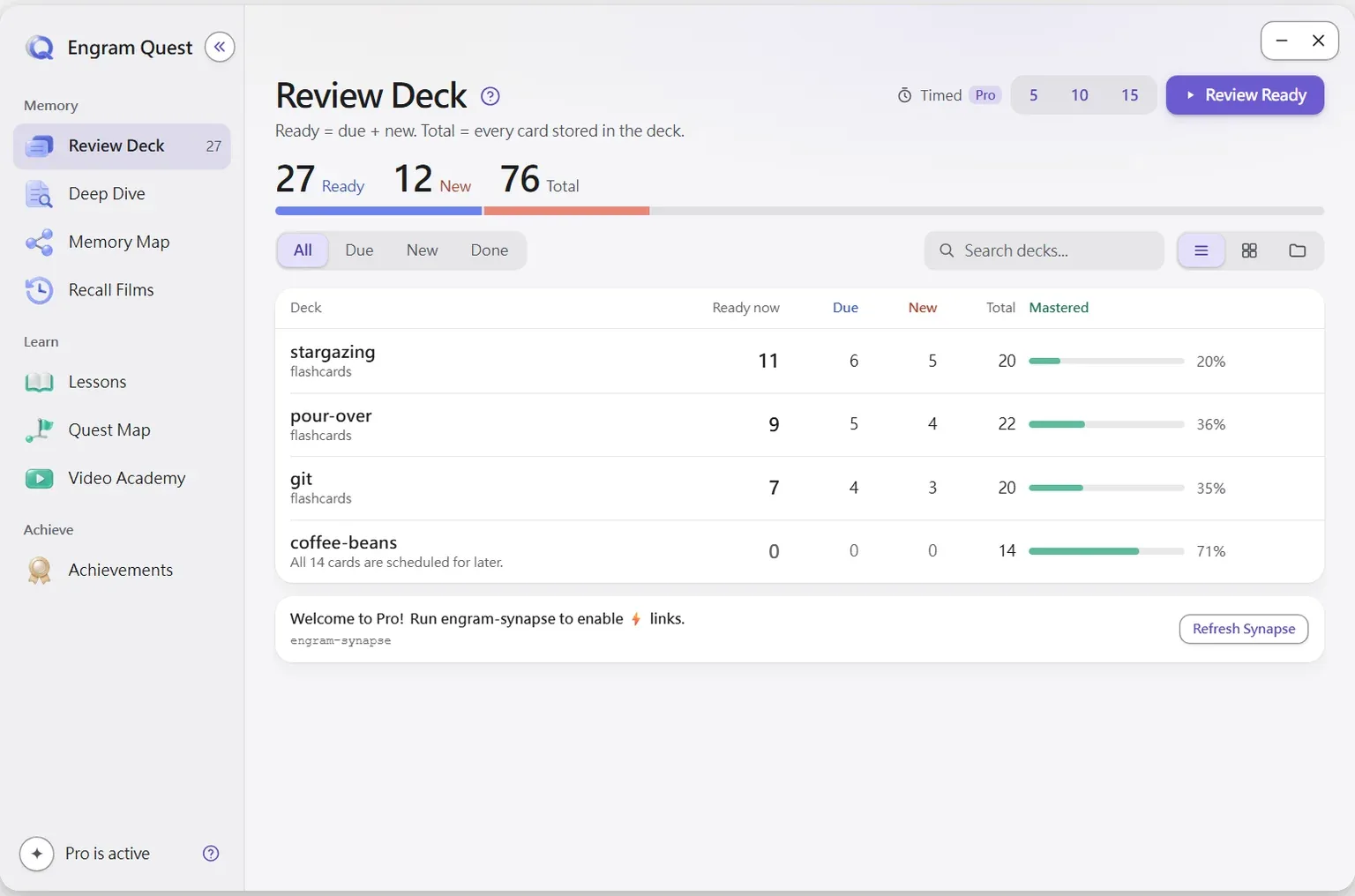
A card opens with the question alone, so you search your memory before any help appears (L1, active recall). If you are stuck, you ask for help one step at a time: L2, a contextual anchor that rebuilds where you first met the idea from your own vault, then L3, a narrowing hint that points in a direction but never gives the full answer. Then you reveal the answer, rate yourself Again, Hard, Good or Easy, and FSRS-5 schedules the next review for close to when you would forget. That is rules 2, 5 and 6 built into the flow. See active recall and spaced repetition for the research, and Review Deck for the feature.
Quest Map: use it in a situation you have not seen
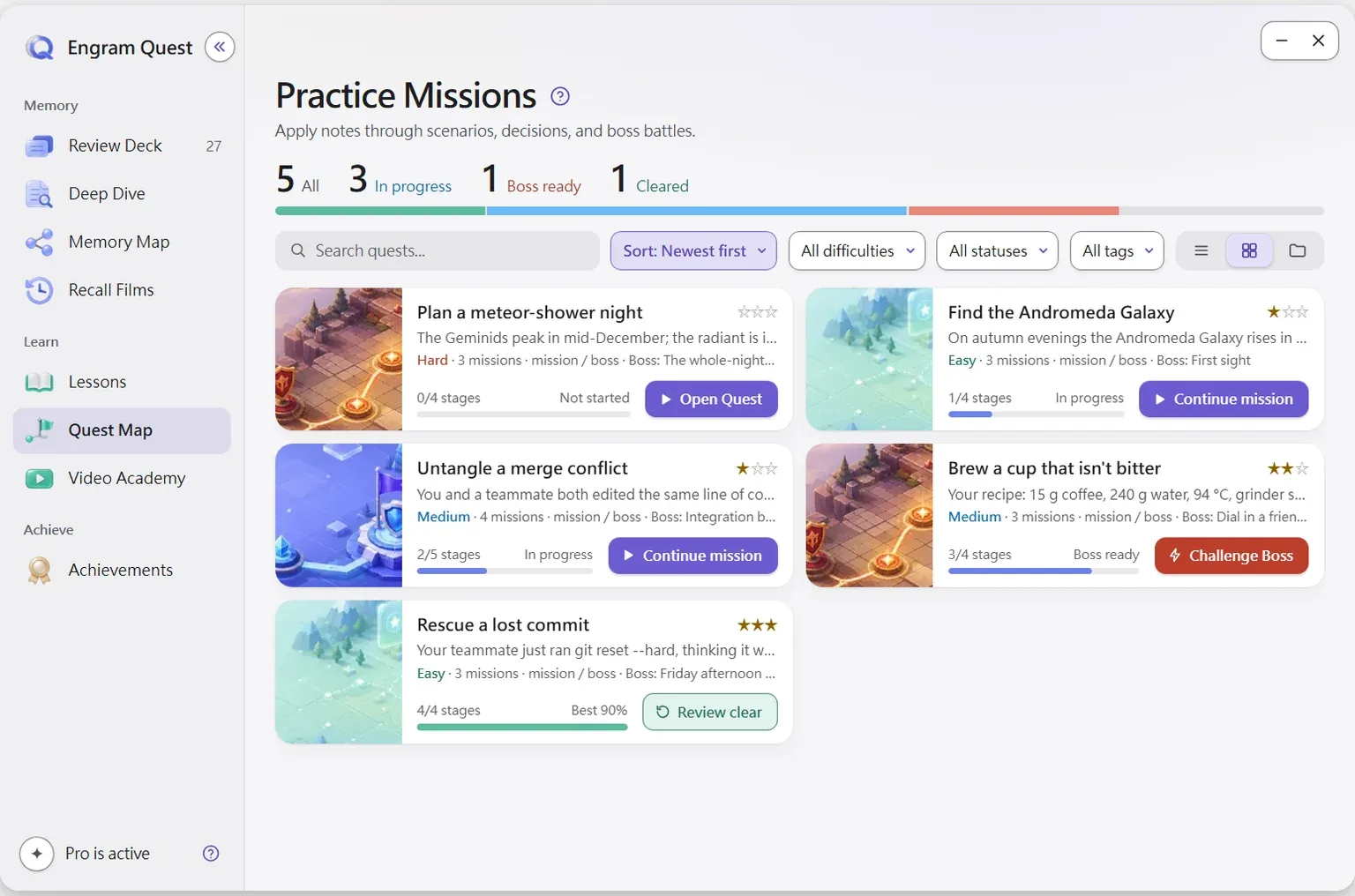
Recall is only part of the job. Quest Map turns a note, a topic or a course into missions that put you in a situation you have not seen, with the real material in front of you, ask you to decide what someone with the skill would do, and score it. Easy, Medium and Hard tiers and a final Boss Battle test judgment, sequencing and tradeoffs. This is the judging job from the framework above, and it follows the research on transfer and desirable difficulties.
Lessons end with a quiz, and cards can be your own
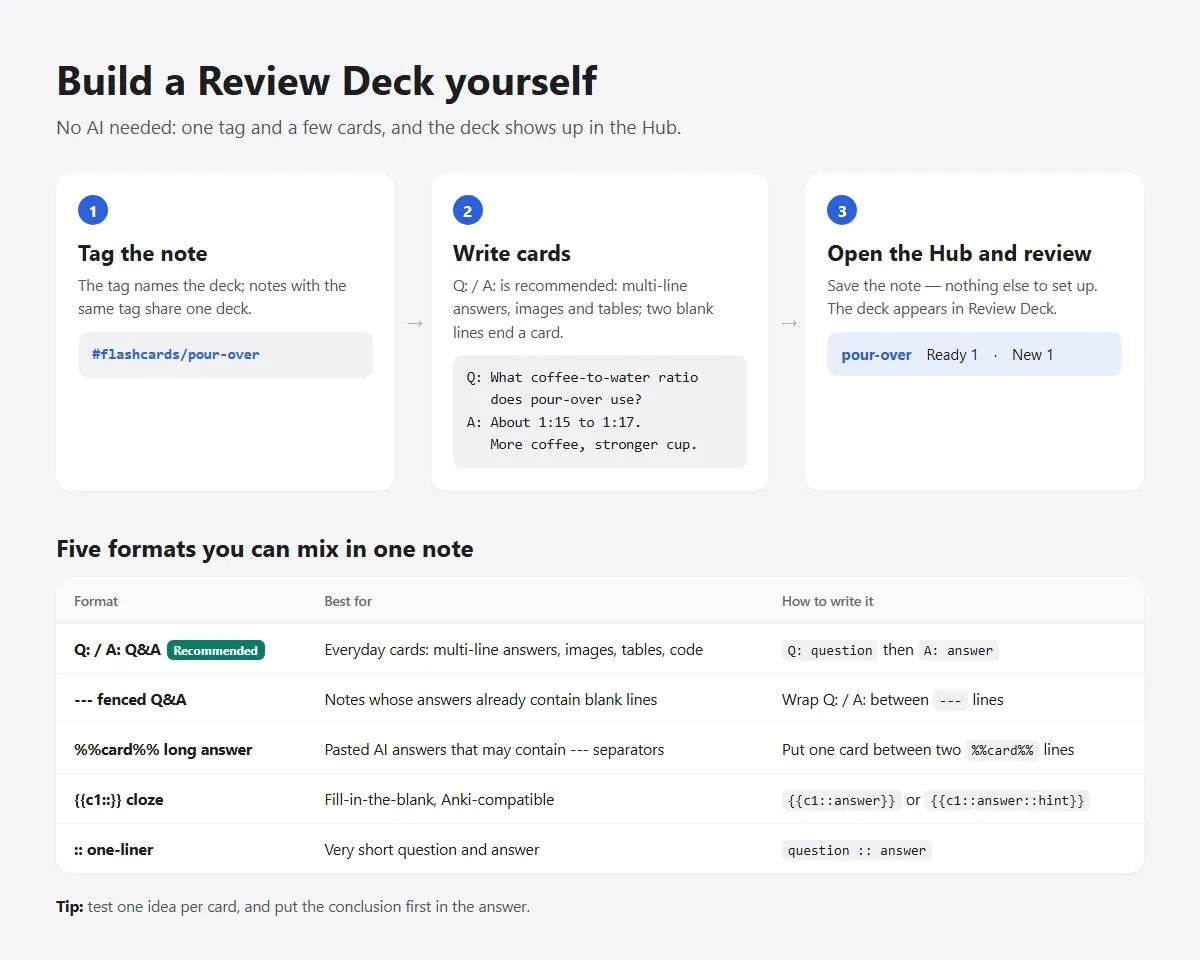
Every lesson in Lessons ends with a quiz, and a finished course can become Review Deck cards or a Quest Map. If you want the generating step for yourself, write the cards by hand: tag a note #flashcards/topic, write Q: and A:, and the deck appears with no AI involved (card formats). Writing your own cards is generation practice in its own right.
What the plugin cannot do for you
The Show Answer button is always there, and nothing stops you from asking a chatbot for the answer in another window. When the AI writes your cards, it has done the card-writing, which is generation you skip. And EngramQuest has not been tested in a controlled trial: it applies the principles above, it does not promise results. The eight rules still apply to you, and the guide shows how to set up both the AI path and the handwritten path.
Frequently asked questions
Does using ChatGPT make you dumber?
No study has shown that AI lowers general intelligence. Several randomised trials do show that using AI to get answers during practice lowers later test scores and retention, because the learner skips the recall and problem solving that build memory.
What is cognitive offloading?
Cognitive offloading is using an outside tool or action, such as a written list, a calculator or a chatbot, to reduce the mental work of a task. It saves effort and is often sensible, but information you offload is less likely to be stored in your own memory.
Is the MIT “Your Brain on ChatGPT” study reliable?
Treat it as preliminary. It is a preprint with 54 participants, only 18 of them in the final crossover session, one task and one tool, and a comment posted on arXiv questions its EEG methods. It suggests lower engagement while writing with ChatGPT, not lasting brain damage.
Can an AI tutor actually help you learn?
Yes, when it is designed to guide rather than answer. A Harvard physics AI tutor that led students step by step produced median learning gains more than double those of in-class active learning, and a hint-only GPT-4 tutor avoided the exam drop seen with an unrestricted one.
How do I study with AI without hurting my memory?
Attempt each problem before you ask, ask for hints instead of answers, close the chat and write what you remember, and test yourself again a few days later. Judge progress by what you can do without the AI, not by how smooth the session felt.
Do I need AI to use EngramQuest?
No. You can write flashcards by hand in a note tagged #flashcards/topic and review them with FSRS scheduling. AI tools can build lessons, cards and Quest Maps from your notes, but the recall is always yours.
Sources
Every research claim in this article links to one of these sources. Preprints are marked as such.
- Bastani, H., Bastani, O., Sungu, A., Ge, H., Kabakcı, Ö., & Mariman, R. (2025). Generative AI without guardrails can harm learning: Evidence from high school mathematics. Proceedings of the National Academy of Sciences, 122(26), e2422633122. doi.org/10.1073/pnas.2422633122
- Barcaui, A. (2025). ChatGPT as a cognitive crutch: Evidence from a randomized controlled trial on knowledge retention. Social Sciences & Humanities Open, article 102287. doi.org/10.1016/j.ssaho.2025.102287
- Shen, J. H., & Tamkin, A. (2026). How AI impacts skill formation. arXiv preprint arXiv:2601.20245. arxiv.org/abs/2601.20245
- Stadler, M., Bannert, M., & Sailer, M. (2024). Cognitive ease at a cost: LLMs reduce mental effort but compromise depth in student scientific inquiry. Computers in Human Behavior, 160, 108386. doi.org/10.1016/j.chb.2024.108386
- Kosmyna, N., Hauptmann, E., Yuan, Y. T., Situ, J., Liao, X.-H., Beresnitzky, A. V., Braunstein, I., & Maes, P. (2025). Your brain on ChatGPT: Accumulation of cognitive debt when using an AI assistant for essay writing task. arXiv preprint arXiv:2506.08872 (MIT Media Lab; not peer reviewed). arxiv.org/abs/2506.08872
- Stankovic, M., Hirche, E., Kollatzsch, S., & Doetsch, J. N. (2025). Comment on “Your brain on ChatGPT: Accumulation of cognitive debt when using an AI assistant for essay writing task”. arXiv preprint arXiv:2601.00856. arxiv.org/abs/2601.00856
- Fan, Y., Tang, L., Le, H., Shen, K., Tan, S., Zhao, Y., Shen, Y., Li, X., & Gašević, D. (2025). Beware of metacognitive laziness: Effects of generative artificial intelligence on learning motivation, processes, and performance. British Journal of Educational Technology, 56(2), 489–530. doi.org/10.1111/bjet.13544
- Gerlich, M. (2025). AI tools in society: Impacts on cognitive offloading and the future of critical thinking. Societies, 15(1), 6. www.mdpi.com/2075-4698/15/1/6
- Lee, H.-P., Sarkar, A., Tankelevitch, L., Drosos, I., Rintel, S., Banks, R., & Wilson, N. (2025). The impact of generative AI on critical thinking: Self-reported reductions in cognitive effort and confidence effects from a survey of knowledge workers. Proceedings of the 2025 CHI Conference on Human Factors in Computing Systems (CHI ’25), Article 1121, 1–22. ACM. doi.org/10.1145/3706598.3713778
- Kestin, G., Miller, K., Klales, A., Milbourne, T., & Ponti, G. (2025). AI tutoring outperforms in-class active learning: An RCT introducing a novel research-based design in an authentic educational setting. Scientific Reports, 15, 17458. doi.org/10.1038/s41598-025-97652-6
- De Simone, M. E., Tiberti, F. H., Barron Rodriguez, M. R., Manolio, F. A., Mosuro, W., & Dikoru, E. J. (2025). From chalkboards to chatbots: Evaluating the impact of generative AI on learning outcomes in Nigeria. Policy Research Working Paper 11125. World Bank. doi.org/10.1596/1813-9450-11125
- Lehmann, M., Cornelius, P. B., & Sting, F. J. (2025). AI meets the classroom: When do large language models harm learning? arXiv preprint arXiv:2409.09047 (v2). arxiv.org/abs/2409.09047
- Humanities and Social Sciences Communications (2026). Retraction note for Wang, J., & Fan, W. (2025), a meta-analysis of the effect of ChatGPT on students’ learning performance. www.nature.com/articles/s41599-026-07310-z
- Slamecka, N. J., & Graf, P. (1978). The generation effect: Delineation of a phenomenon. Journal of Experimental Psychology: Human Learning and Memory, 4(6), 592–604. doi.org/10.1037/0278-7393.4.6.592
- Roediger, H. L., III, & Karpicke, J. D. (2006). Test-enhanced learning: Taking memory tests improves long-term retention. Psychological Science, 17(3), 249–255. doi.org/10.1111/j.1467-9280.2006.01693.x
- Bjork, E. L., & Bjork, R. A. (2011). Making things hard on yourself, but in a good way: Creating desirable difficulties to enhance learning. In M. A. Gernsbacher, R. W. Pew, L. M. Hough, & J. R. Pomerantz (Eds.), Psychology and the real world: Essays illustrating fundamental contributions to society (pp. 56–64). Worth Publishers. bjorklab.psych.ucla.edu/wp-content/uploads/sites/13/2016/04/EBjork_RBjork_2011.pdf
- Risko, E. F., & Gilbert, S. J. (2016). Cognitive offloading. Trends in Cognitive Sciences, 20(9), 676–688. doi.org/10.1016/j.tics.2016.07.002
- Sparrow, B., Liu, J., & Wegner, D. M. (2011). Google effects on memory: Cognitive consequences of having information at our fingertips. Science, 333(6043), 776–778. doi.org/10.1126/science.1207745
- Camerer, C. F., Dreber, A., Holzmeister, F., et al. (2018). Evaluating the replicability of social science experiments in Nature and Science between 2010 and 2015. Nature Human Behaviour, 2(9), 637–644. doi.org/10.1038/s41562-018-0399-z
About this article
powen is the creator and developer of EngramQuest, a free Obsidian plugin that turns notes into lessons, teaching videos, practice quests and FSRS flashcards. Articles here are researched and drafted with AI help; every study cited is checked against the original paper, and plugin details come from the plugin's own documentation and source code.
How EngramQuest uses memory science