No AI needed
Write flashcards by hand, in five formats
EngramQuest finds flashcards in any Obsidian note tagged #flashcards/topic. Write cards in five formats, mix them in one note, and they appear in Review Deck, scheduled with FSRS.
Tag, write, review
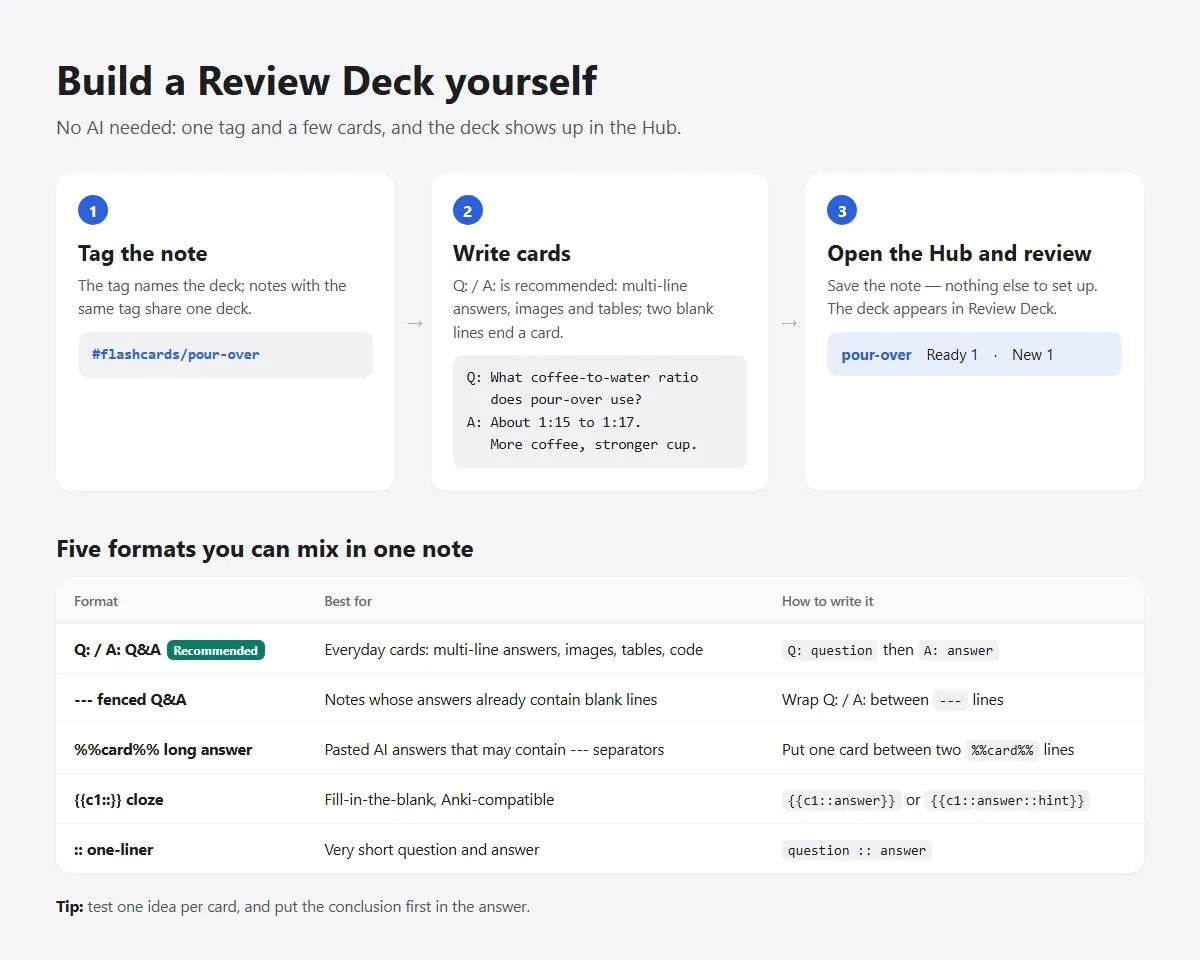
The five formats at a glance
| Format | Best for | How to write it |
|---|---|---|
Q: / A:Recommended | Everyday cards: multi-line answers, images, tables, code | Q: question, then A: answer. Two blank lines end the card. |
--- fenced Q&A | Notes whose answers already contain blank lines | Wrap Q: / A: between --- lines |
%%card%% long answer | Pasted AI answers that may contain --- separators | Put one card between two %%card%% lines |
{{c1::}} clozeAnki-compatible | Fill-in-the-blank | {{c1::answer}} or {{c1::answer::hint}} |
:: one-linerAnki-compatible | Very short question and answer | question :: answer |
Copy an example
Each block is a complete note. Paste it into Obsidian and it becomes a deck.
Q: / A:
Derivatives.md#flashcards/math Q: What is a derivative? A: The instantaneous rate of change of a function at a point. Formally: lim(h→0) [f(x+h) − f(x)] / h Q: What does the second derivative tell you? A: How the slope itself is changing: the curve's concavity.--- fenced Q&A
Payments.md#flashcards/system-design --- Q: What is Stripe's core model? A: Stripe is essentially a Saga system. It handles the payment_intent state machine, retries and fund consistency. ---%%card%% long answer
Testing.md#flashcards/ai %%card%% Q: How should I explain agentic testing? A: Agentic testing checks whether an AI system can complete a task reliably. --- This separator stays inside the answer. %%card%%{{c1::}} cloze
Calculus.md#flashcards/math {{c1::Calculus}} is built on limits, derivatives and integrals. The derivative of sin x is {{c1::cos x::a trig function}}.:: one-liner
Formulas.md#flashcards/math Pythagorean theorem :: a² + b² = c² Area of a circle :: πr²Shortcut for
%%card%%On an empty line press Ctrl + / or Cmd + /
Obsidian inserts
%% %%with the cursor inside. Typecardand you have%%card%%.
How EngramQuest finds your cards
By tag
Any note tagged #flashcards/topic is picked up automatically. The part after the prefix is the deck name: #flashcards/math becomes the math deck.
Your own prefixes
Settings → EngramQuest → Flashcard tag prefixes lets you add more prefixes, such as card or azure-card.
Edits write back
Fix a card during review and the change is saved to your source note.
Using Anki too?
The :: and {{c1::}} formats are Anki-compatible: pair them with the Obsidian_to_Anki community plugin. Q: / A: is EngramQuest's own format, built for rich multi-line answers, and does not sync to Anki.
Rather let AI write them?
Install the skills and say "Make a Review Deck from my notes on photography". AI cards are saved in engram-review/ai-cards/, and your notes stay untouched.
Questions
Which format should I use?
Start with Q: / A:. It is the recommended everyday format: answers can span several lines and hold images, tables and code, and two blank lines end the card. Use the others when they fit better.
How do I make a cloze card?
Wrap the hidden part in {{c1::...}}, for example {{c1::Calculus}} is built on limits. Add a hint after a second pair of colons: {{c1::cos x::a trig function}}.
How does EngramQuest find my cards?
By tag. Add #flashcards/topic anywhere in the note; the part after flashcards/ becomes the deck name. You can add more tag prefixes in Settings → EngramQuest.
Are these formats Anki-compatible?
The :: one-liner and {{c1::}} cloze formats are. Sync them to Anki with the Obsidian_to_Anki plugin. Q: / A: cards stay in EngramQuest.
Is there a shortcut for %%card%%?
Yes. Press Ctrl+/ (Cmd+/ on a Mac) on an empty line. Obsidian inserts %% %% with the cursor in the middle; type card.
Can I mix formats in one note?
Yes. All five formats can be mixed freely in the same note.




Keep what you learn.
Free for Obsidian on desktop and mobile. AI optional.
Free community plugin · Opens Obsidian. Nothing happens? Install from the plugin directory (opens in a new tab)