
Learning science
How to learn in the age of AI: what to keep in your head, and how to make it stick
Key takeaways
- Recent studies point one way: AI that hands over answers can raise practice scores and lower what you can do alone, while AI built to make you think can improve learning.[1][5]
- Keep in your head what you need faster than a search, what you need to check an AI’s answer, and what your next learning builds on. Leave the rest to lookup.
- The Own-It Loop has four steps: Own (choose what to keep), Build (let AI make the material, after you try first), Recall (answer before you look), and Space and apply.
- In our FSRS-6 simulation (not user data), keeping 1,000 flashcards at 90% retention took about 26 reviews a day over the first year, roughly 4 to 5 minutes at 10 seconds a review, and about 9 a day once no new cards were added.[20]
AI can explain almost anything on demand, so access to answers is no longer the scarce part. Knowledge you can use without looking is, and so is enough of it to judge what the AI tells you. Below: what is worth owning, what learning research says about making it stick, a four-step loop for learning with AI, and an open-source FSRS simulation of what remembering costs per day.
What changes about learning when AI can answer anything?
Finding an answer is now almost free. What AI does not give you is knowledge that is ready in your head when you need it, and the background to tell a good answer from a plausible wrong one. Those still have to be built the slow way, through your own retrieval.
The clearest evidence so far is about who does the thinking. In a field experiment with nearly 1,000 high school math students, access to a standard GPT-4 chat improved practice scores by 48%, but once access was taken away those students scored 17% lower than students who never had it. A version with guardrails, which gave hints instead of answers, improved practice by 127% and largely removed the harm.[1]
Other studies point the same way. In a randomized study of 117 university students writing an essay, the ChatGPT group improved their essays the most, yet knowledge gain and transfer did not differ from the other groups; the authors warn of metacognitive laziness.[2] In an MIT Media Lab preprint with 54 participants, people who wrote with an LLM showed the weakest brain connectivity on EEG and struggled to quote their own essays.[3] It is small and not peer reviewed: a signal, not a verdict. In a survey of knowledge workers, higher confidence in AI went with less self-reported critical thinking.[4]
The other side matters just as much. In a randomized crossover study in a Harvard physics course (194 students), an AI tutor built on learning-science practice (short replies, one step at a time, try before you see the answer) produced more than twice the learning gains of an active-learning lecture, in less time.[5] It covered two lessons in one course, but it shows the tool itself is not the problem.
AI does not make learning better or worse by itself. When the AI does the retrieving and reasoning, practice looks better and independent performance can fall; when it makes you retrieve and reason, learning can improve.[1][5]
What is still worth putting in your own head?
Keep in your head what passes at least one of three tests: you need it faster than you can look it up, you need it to judge an AI’s answer, or later learning builds on it. Everything else can live in your notes and in the AI.
| Test | Ask yourself | Typical examples |
|---|---|---|
| Speed | Will I need this mid-conversation, in an exam, a meeting or a fix, with no time to search? | The core vocabulary of your field, key formulas, everyday commands and shortcuts |
| Judgment | Would I notice if the AI got this wrong? | Main concepts and rules of thumb, typical numbers and orders of magnitude, common failure modes |
| Foundation | Will the next things I learn sit on top of this? | Course prerequisites, the mental model of a system you work in |
| Leave to lookup | Is it rare, quick to check, or changing fast? | Exact API signatures, version-specific settings, a date you need once a year |
The judgment test is the one AI makes more important. Research on cognitive load shows that what you already know changes how you learn: detailed guidance that helps a novice can slow down a learner who knows more, an effect called expertise reversal.[6] The same stored knowledge is what lets you read an AI answer critically instead of accepting it. If you cannot check an answer, you are not using a tool. You are trusting one.
Owning is also a budget. Every item you decide to keep costs a little review time every day for months. The simulation below puts a number on that budget, so you can spend it on purpose.
In the AI era, the things worth remembering are the ones you need faster than a search, the ones you need to check an AI’s answer, and the ones your next learning builds on.
What does learning science say makes knowledge stick?
Decades of research agree on one idea: memories get stronger when you work to pull them out, spread over time, in varied situations. In a large review of study techniques, practice testing and distributed practice rated highest, while rereading and highlighting rated low.[15]
| Principle | What the research found | With AI, this means |
|---|---|---|
| Retrieval practice | Taking a recall test beat restudying on a test a week later, even though restudying looked better after five minutes.[7] Retrieval also beat building concept maps.[8] | Close the chat and answer from memory before you check. |
| Spacing | Spreading study over time improves long-term retention, and the best gap grows with how long you need to remember.[9] | Let a scheduler bring items back at growing intervals instead of cramming. |
| Generation | Information people produce themselves is remembered better than information they read, across many studies.[10][11] | Write your own explanation or example first, then ask the AI to critique it. |
| Trying first | Failed attempts to answer before seeing the answer still improved later learning.[12] | Ask the AI to quiz you before it explains. |
| Desirable difficulties | Conditions that slow learning in the moment, such as spacing, testing and variation, often help retention and transfer later.[13] | Do not aim for a smooth session. Aim for next month. |
| Interleaving | Mixing problem types helps, but the benefit depends on the material; similarity between the categories matters.[14] | Mix related topics that are easy to confuse in one review session. |
| Elaboration | Asking why and explaining to yourself rated moderately useful.[15] | Ask yourself “why is this true?” and answer before you ask the AI. |
| Transfer | Retrieval practice transfers to new questions and formats, with an average effect of d = 0.40 across 122 experiments.[16] | Practise the idea in situations you have not seen. |
| Metacognition | Students in active classes learned more but felt they learned less.[17] Most students choose rereading over self-testing.[18] | Do not trust the feeling of fluency. Test yourself. |
| Cognitive load | Instruction that helps novices can hinder learners who know more.[6] | Tell the AI your level, and ask for less guidance as you improve. |
The common thread is uncomfortable. The methods that feel best in the moment, reading a clear explanation, rereading, getting a fluent answer from a chatbot, are the ones that leave the least behind. AI makes the comfortable path even smoother, which is why it needs a deliberate counterweight.
Feeling that you learned is a poor guide: in a Harvard physics study, students in active-learning classes scored higher on tests but felt they had learned less than students in polished lectures.[17]
How should you learn with AI? The Own-It Loop
Use AI for the work it is good at, building material, and keep for yourself the work that builds memory, generating and retrieving. We call this the Own-It Loop: Own what you choose to keep, let AI Build the material after you try first, Recall before you look, then Space and apply. The name and structure are ours; each step rests on the research above.
| Step | Evidence | Concrete action | What you end with |
|---|---|---|---|
| Own | Expertise reversal, cognitive load[6] | Write 3–7 “Without looking, I can…” lines | A short target list |
| Build | Generation, trying first[11][12] | Answer the AI’s questions before its explanation | A lesson pitched at your level |
| Recall | Retrieval practice[7][8] | Close the chat, answer, check | Cards made only from misses |
| Space and apply | Spacing, transfer[9][16] | Daily scheduled reviews and one new-situation task a week | Knowledge you can use without looking |
1. Own: write a can-do list
Before you open the AI, write three to seven lines that start with “Without looking, I can…”. For example: “Without looking, I can explain why a pour-over tastes sour and which variable to change.” This list is the target for everything that follows, and it stops you from turning a whole chat log into flashcards.
2. Build: let AI make the material, but try first
AI is very good at turning notes into lessons, worked examples, diagrams and questions. Tell it your level, and ask it to question you before it explains. A failed first attempt still helps the explanation stick,[12] and writing your own short explanation first uses the generation effect.[11]
Prompt for any AI tool
I am learning [topic]. My level: [beginner / some experience].
Goal: without looking, I can [your can-do list].
1. Ask me 3 questions first and wait for my answers.
2. Then explain only what I got wrong or missed, one step at a time.
3. End with 10 recall questions that test the goal, questions only.3. Recall: answer before you look
Close the chat. Answer each question in writing or out loud, then check. Retrieval is the step that builds memory, and it is the step AI most easily takes away.[7][1] Every question you miss or answer slowly becomes a flashcard. Questions you answer at once do not need one.
4. Space and apply
Let a spaced repetition scheduler such as FSRS decide when each card comes back.[19] Once a week, use the idea in a situation you have not seen: a new problem, a decision at work, explaining it to a colleague. Retrieval practice transfers best when the practice resembles the use.[16]
How much daily review does it take to keep what you learn?
In our simulation with the open-source FSRS scheduler, keeping 1,000 flashcards at 90% desired retention took about 26 reviews a day averaged over the first year, about 4.4 minutes at 10 seconds a review. Once the deck stopped growing, upkeep fell to about 9 reviews a day. Adding 10 new cards every day for a whole year grew to about 100 reviews a day, close to 17 minutes, by the end.
How the simulation works
- Scheduler: py-fsrs 6.3.3 from the open-spaced-repetition project (FSRS-6) with all defaults: 21 parameters, learning steps of 1 and 10 minutes, a 10-minute relearning step, interval fuzzing. FSRS grew out of the model Ye, Su and Cao published at KDD 2022.[19][20]
- Desired retention 0.80, 0.90 or 0.95. Ten new cards a day for 365 days, until the deck holds 100, 500 or 1,000 cards, or with no cap (3,650).
- Each card is reviewed exactly when due. The first view of a new card is rated Good, since you have just studied the material. Every later review is rated Good with probability equal to FSRS’s predicted recall for that card at that moment, and Again otherwise.
- Every review, including same-day steps, takes 10 seconds; at 20 seconds, double the minutes.
- Five random seeds per scenario; the tables show the means.
| Deck size | Reviews/day, year average | Minutes/day, year average | Reviews/day, last 30 days | Busiest day (reviews) | Predicted recall at day 365 |
|---|---|---|---|---|---|
| 100 | 2.7 | 0.4 | 0.8 | 36 | 95.7% |
| 500 | 13.8 | 2.3 | 3.5 | 64 | 96.2% |
| 1,000 | 26.3 | 4.4 | 9.0 | 82 | 96.6% |
| 3,650 (no cap) | 77.2 | 12.9 | 100.8 | 120 | 95.5% |
| Desired retention | 1,000 cards: reviews/day, year average | No cap: reviews/day, year average | No cap: minutes/day, last 30 days | No cap: predicted recall at day 365 |
|---|---|---|---|---|
| 0.80 | 19.7 | 58.5 | 12.1 | 89.8% |
| 0.90 | 26.3 | 77.2 | 16.8 | 95.5% |
| 0.95 | 36.6 | 106.1 | 22.7 | 97.6% |
What the numbers say
- Keeping is cheap; adding is what costs. A finished 1,000-card deck needed about 9 reviews (1.5 minutes) a day by the end of the year. Most of the load comes from new cards in their first weeks.
- Your intake rate sets your daily time. Ten new cards every day reached about 100 reviews a day after a year. That is why the Own step comes first.
- 0.90 is a sensible default. Moving to 0.95 cost 37–39% more reviews for 1 to 2 points more predicted recall. Dropping to 0.80 saved about a quarter of the reviews and lost 6 to 8 points.
- Understanding first saves reviews. When we rated every new card’s first view as Again, as if you met it cold, the 1,000-card deck needed 47.8 reviews a day instead of 26.3, about 80% more. Learning the idea before you memorize it pays off in review time too.
- The plugin’s own code agrees. A Python port of EngramQuest’s FSRS-5 scheduling code gave almost the same load at 0.90: 26.4 reviews a day for 1,000 cards.
In an FSRS-6 simulation with default parameters, keeping 1,000 flashcards at 90% retention cost about 26 reviews a day over the first year, about 4 to 5 minutes at 10 seconds a review, and about 9 a day once no new cards were added.[20]
The rating model at the heart of the simulation (py-fsrs 6.3.3)
r = scheduler.get_card_retrievability(card, now)   # FSRS's predicted recall
rating = Rating.Good if rng.random() < r else Rating.Again
card, _ = scheduler.review_card(card, rating, now)Limits: the model assumes FSRS predicts your memory perfectly. Real people have uneven cards, press Hard and Easy, and skip days. Parameters fitted to your own history would shift the numbers. Read the tables for proportions and scale, not as a promise.
How do you run the Own-It Loop in Obsidian?
You can run the loop with any notes app and any flashcard tool. EngramQuest is the Obsidian plugin we built around it: AI builds study material from your notes, you do the recall, and FSRS schedules the reviews. The plugin is free to install and use, and AI is optional.
- Own: your notes stay the source. AI-generated cards are stored in a separate folder, and the AI never edits your notes.
- Build: the AI tool you already use (Claude Code, Codex, Gemini CLI, Cursor and others) turns a note or a topic into a course in Lessons with a quiz at the end of each lesson, short teaching videos made with Claude Code, Quest Map missions, or Review Deck cards. Without AI, tag a note #flashcards/topic and write Q: and A: lines by hand.
- Recall: in the Review Deck every card starts as the question alone. If you are stuck, the next hint rebuilds the context in your vault where you first learned the idea, and the last hint gives a keyword direction, never the full answer.
- Space: FSRS-5 schedules every card. Target retention is a setting (0.70 to 0.99, default 0.90), the same knob the simulation turns.
- Apply: Quest Map missions put you in a situation you have not seen, and a Boss Battle at the end tests judgment on an applied case.
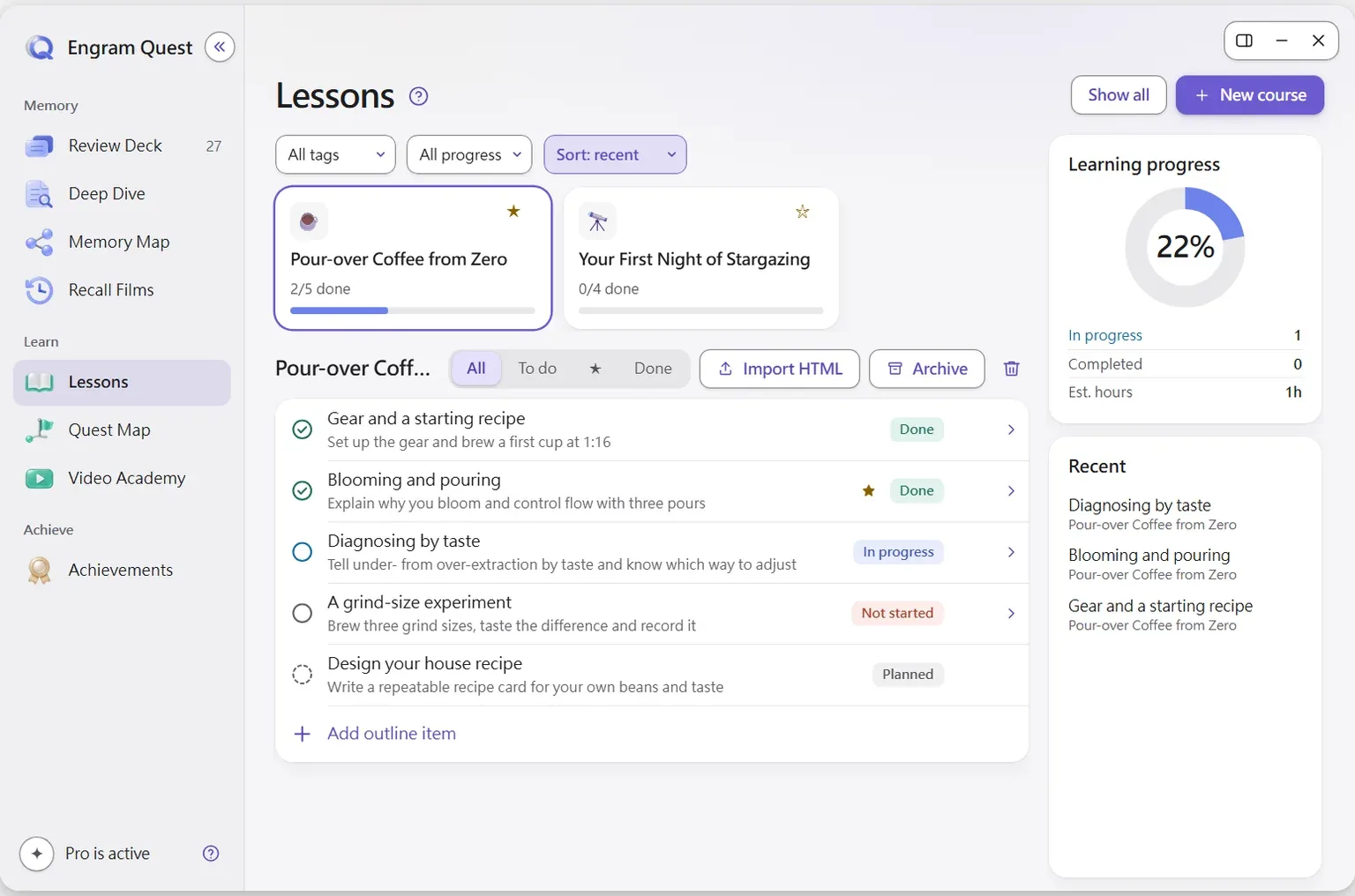
Example requests to your AI tool
Teach me pour-over coffee at beginner level, using my notes.
Build a review deck from my notes tagged coffee.
Turn Pour-over.md into a quest-map medium.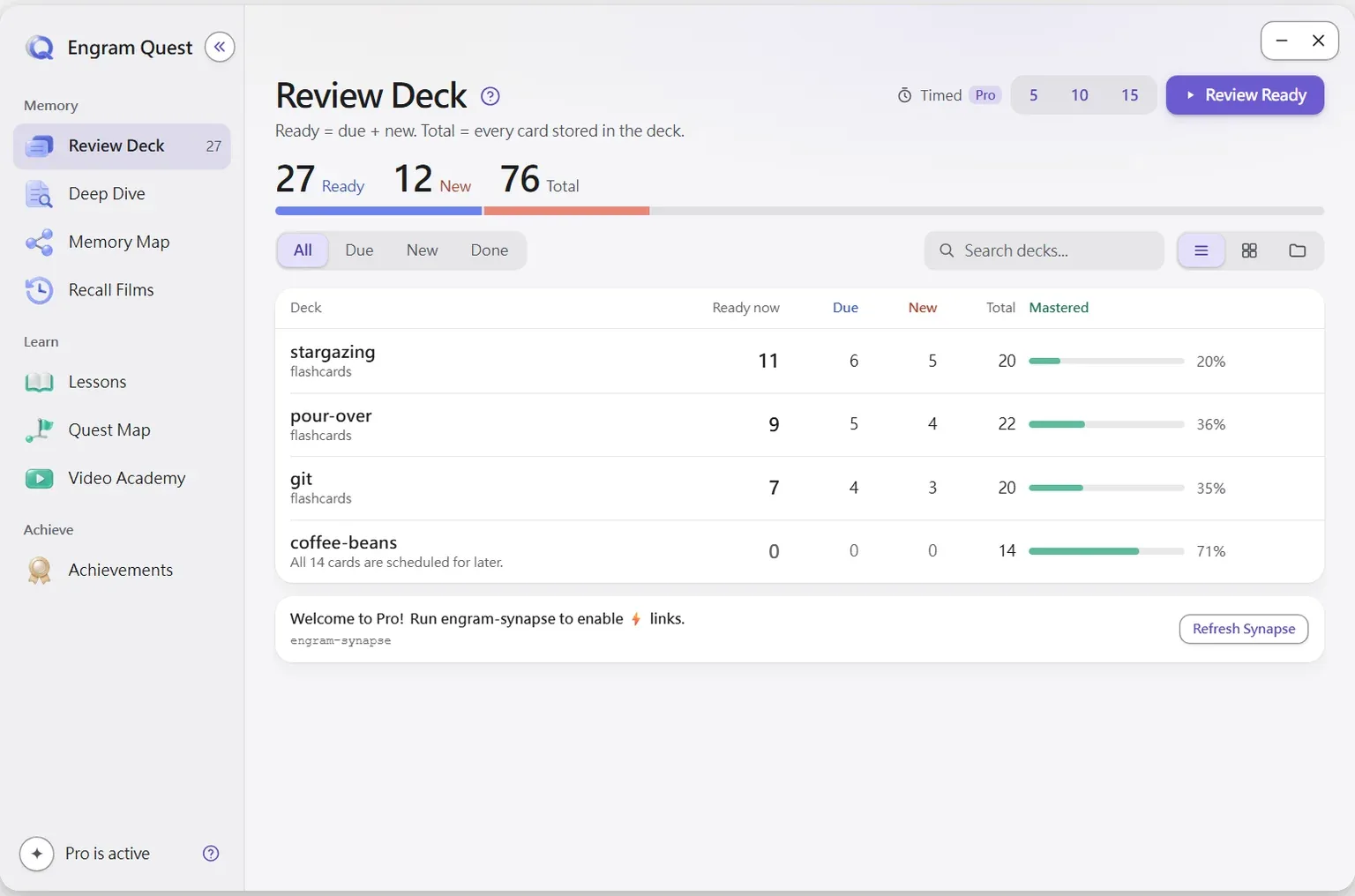
The guide walks through setup step by step, and the science page shows how each feature maps to the research above.
What can you do this week?
Start with one topic and one week. The loop is small on purpose.
- Pick one topic and write five “Without looking, I can…” lines.
- Ask your AI tool for a short lesson at your level, questions first.
- Close the chat, answer, and make cards only from your misses.
- Review about five minutes a day; at week’s end, use the topic once in a new situation.
Frequently asked questions
Is it still worth memorizing things when AI can look them up?
Yes, for a smaller, chosen set: what you need faster than a search, what you need to check an AI’s answer, and what later learning builds on. The rest can stay in your notes and be looked up.
How do I study with ChatGPT or Claude without it doing the thinking for me?
Ask it to question you before it explains, answer from memory before you check, and ask for hints instead of solutions. In a field study with high school students, a GPT-4 tutor with these guardrails avoided the drop in exam scores seen with an unrestricted chat.
How much daily review does it take to keep 1,000 flashcards?
In our FSRS-6 simulation at 90% retention, about 26 reviews a day averaged over the first year, roughly 4 to 5 minutes at 10 seconds a card, falling to about 9 a day once no new cards were added. It is a simulation, not user data.
What desired retention should I use with FSRS?
0.90 is a sensible default. In our simulation, 0.95 cost 37–39% more reviews for 1 to 2 points more recall, while 0.80 saved about a quarter of the reviews but lost 6 to 8 points.
Do spaced repetition and active recall still matter in the AI era?
Yes. AI changes how study material is made, not how memory works: spacing and retrieval still decide what you can recall without help weeks later.
Can AI write my flashcards for me?
Yes, AI can draft good questions from your notes and save hours. The recall still has to be yours, so read each card, delete what you do not need, and answer before you look.
Sources
Every research claim in this article links to one of these sources. Preprints are marked as such.
- Bastani, H., Bastani, O., Sungu, A., Ge, H., Kabakcı, Ö., & Mariman, R. (2025). Generative AI without guardrails can harm learning: Evidence from high school mathematics. Proceedings of the National Academy of Sciences, 122(26), e2422633122. doi.org/10.1073/pnas.2422633122
- Fan, Y., Tang, L., Le, H., Shen, K., Tan, S., Zhao, Y., Shen, Y., Li, X., & Gašević, D. (2025). Beware of metacognitive laziness: Effects of generative artificial intelligence on learning motivation, processes, and performance. British Journal of Educational Technology, 56(2), 489–530. doi.org/10.1111/bjet.13544
- Kosmyna, N., Hauptmann, E., Yuan, Y. T., Situ, J., Liao, X.-H., Beresnitzky, A. V., Braunstein, I., & Maes, P. (2025). Your brain on ChatGPT: Accumulation of cognitive debt when using an AI assistant for essay writing task. arXiv preprint arXiv:2506.08872 (not peer reviewed). arxiv.org/abs/2506.08872
- Lee, H.-P., Sarkar, A., Tankelevitch, L., Drosos, I., Rintel, S., Banks, R., & Wilson, N. (2025). The impact of generative AI on critical thinking: Self-reported reductions in cognitive effort and confidence effects from a survey of knowledge workers. Proceedings of the 2025 CHI Conference on Human Factors in Computing Systems (CHI ’25), 1–22. ACM. doi.org/10.1145/3706598.3713778
- Kestin, G., Miller, K., Klales, A., Milbourne, T., & Ponti, G. (2025). AI tutoring outperforms in-class active learning: An RCT introducing a novel research-based design in an authentic educational setting. Scientific Reports, 15, 17458. doi.org/10.1038/s41598-025-97652-6
- Kalyuga, S., Ayres, P., Chandler, P., & Sweller, J. (2003). The expertise reversal effect. Educational Psychologist, 38(1), 23–31. doi.org/10.1207/S15326985EP3801_4
- Roediger, H. L., III, & Karpicke, J. D. (2006). Test-enhanced learning: Taking memory tests improves long-term retention. Psychological Science, 17(3), 249–255. doi.org/10.1111/j.1467-9280.2006.01693.x
- Karpicke, J. D., & Blunt, J. R. (2011). Retrieval practice produces more learning than elaborative studying with concept mapping. Science, 331(6018), 772–775. doi.org/10.1126/science.1199327
- Cepeda, N. J., Pashler, H., Vul, E., Wixted, J. T., & Rohrer, D. (2006). Distributed practice in verbal recall tasks: A review and quantitative synthesis. Psychological Bulletin, 132(3), 354–380. doi.org/10.1037/0033-2909.132.3.354
- Slamecka, N. J., & Graf, P. (1978). The generation effect: Delineation of a phenomenon. Journal of Experimental Psychology: Human Learning and Memory, 4(6), 592–604. doi.org/10.1037/0278-7393.4.6.592
- Bertsch, S., Pesta, B. J., Wiscott, R., & McDaniel, M. A. (2007). The generation effect: A meta-analytic review. Memory & Cognition, 35(2), 201–210. doi.org/10.3758/BF03193441
- Kornell, N., Hays, M. J., & Bjork, R. A. (2009). Unsuccessful retrieval attempts enhance subsequent learning. Journal of Experimental Psychology: Learning, Memory, and Cognition, 35(4), 989–998. doi.org/10.1037/a0015729
- Bjork, R. A., & Bjork, E. L. (2020). Desirable difficulties in theory and practice. Journal of Applied Research in Memory and Cognition, 9(4), 475–479. doi.org/10.1016/j.jarmac.2020.09.003
- Brunmair, M., & Richter, T. (2019). Similarity matters: A meta-analysis of interleaved learning and its moderators. Psychological Bulletin, 145(11), 1029–1052. doi.org/10.1037/bul0000209
- Dunlosky, J., Rawson, K. A., Marsh, E. J., Nathan, M. J., & Willingham, D. T. (2013). Improving students’ learning with effective learning techniques: Promising directions from cognitive and educational psychology. Psychological Science in the Public Interest, 14(1), 4–58. doi.org/10.1177/1529100612453266
- Pan, S. C., & Rickard, T. C. (2018). Transfer of test-enhanced learning: Meta-analytic review and synthesis. Psychological Bulletin, 144(7), 710–756. doi.org/10.1037/bul0000151
- Deslauriers, L., McCarty, L. S., Miller, K., Callaghan, K., & Kestin, G. (2019). Measuring actual learning versus feeling of learning in response to being actively engaged in the classroom. Proceedings of the National Academy of Sciences, 116(39), 19251–19257. doi.org/10.1073/pnas.1821936116
- Karpicke, J. D., Butler, A. C., & Roediger, H. L., III (2009). Metacognitive strategies in student learning: Do students practise retrieval when they study on their own? Memory, 17(4), 471–479. doi.org/10.1080/09658210802647009
- Ye, J., Su, J., & Cao, Y. (2022). A stochastic shortest path algorithm for optimizing spaced repetition scheduling. Proceedings of the 28th ACM SIGKDD Conference on Knowledge Discovery and Data Mining (KDD ’22), 4381–4390. doi.org/10.1145/3534678.3539081
- Open Spaced Repetition. py-fsrs: Python package implementing the Free Spaced Repetition Scheduler (FSRS-6), version 6.3.3. MIT License. GitHub. github.com/open-spaced-repetition/py-fsrs
About this article
powen is the creator and developer of EngramQuest, a free Obsidian plugin that turns notes into lessons, teaching videos, practice quests and FSRS flashcards. Articles here are researched and drafted with AI help; every study cited is checked against the original paper, and plugin details come from the plugin's own documentation and source code.
How EngramQuest uses memory science